






The Rare Three-in-One Spring Begins Phenomenon and Industrial Display Technology
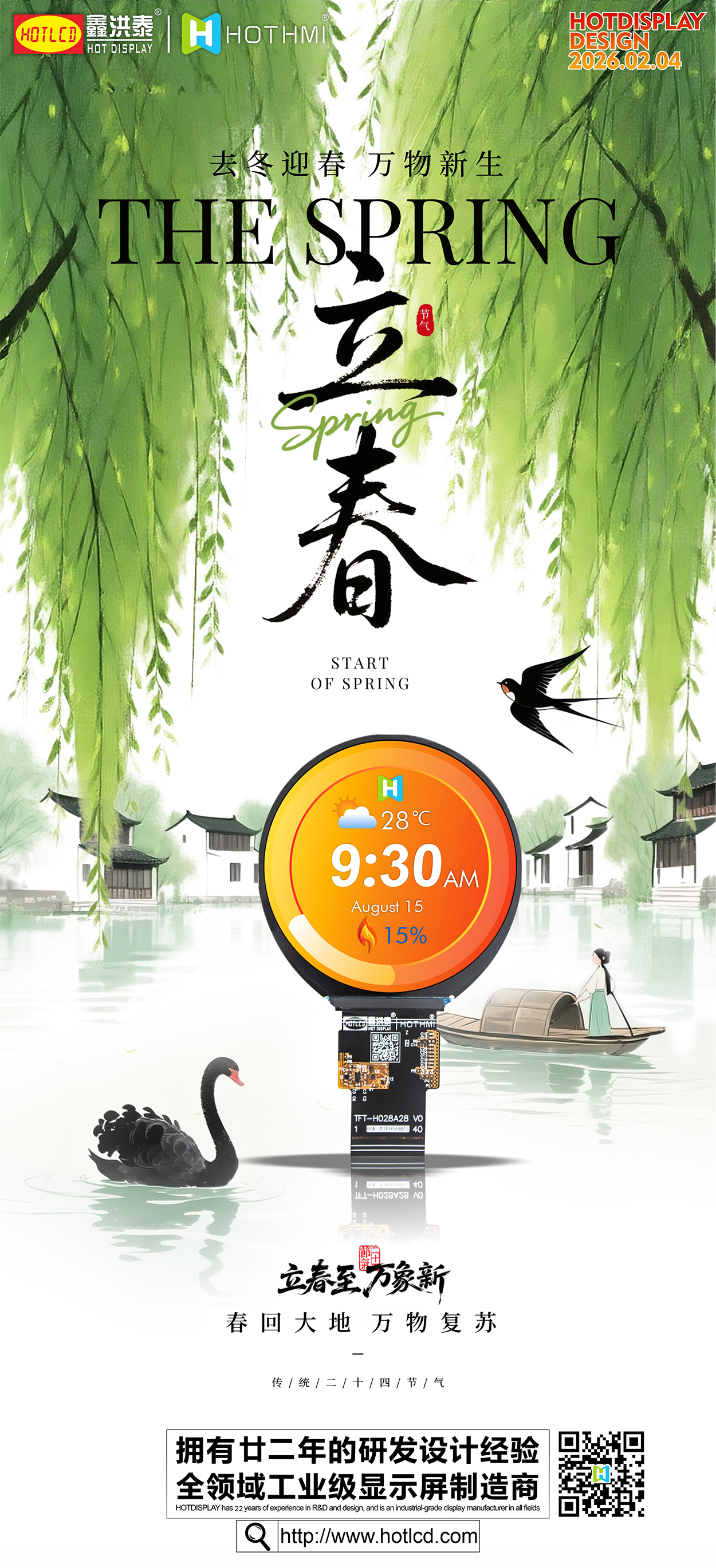
On February 4, 2026, at 4:01:51 AM, the sun reaches a celestial longitude of 315°, marking the precise arrival of Lichun (立春), the first of the 24 solar terms in the traditional Chinese calendar. This day is exceptionally notable as it uniquely combines three conditions seldom seen together: "Early Lichun" (早立春), "Closed-Eye Spring" (閉眼春), and "Spring Hits the Head of the Sixth Nine" (春打六九頭). Such a convergence is so rare that it is colloquially termed a "once-in-60-years event." The last occurrence was in 1966, and the next is projected for 2086. This phenomenon represents a sophisticated interplay of astronomy, calendrical systems, and folk culture.
"Early Lichun" refers to Lichun occurring before the Chinese Lunar New Year. In 2026, Lichun falls on the 17th day of the twelfth lunar month, while the New Year begins on the first day of the first lunar month, creating a 13-day gap and the pattern of "spring before the New Year." This configuration appears only every few decades.
"Closed-Eye Spring" relates to the specific time of transition. When Lichun occurs between midnight and 6:00 AM—while people are typically asleep—it earns this name. The 2026 transition at 4:01 AM fits this criterion. An associated folk saying, "Open-eye spring brings loss, closed-eye spring brings harvest," views a nighttime transition as an auspicious sign for abundance.
Furthermore, 2026's Lichun coincides with the first day of "Liu Jiu" (六九, the Sixth Nine), a period in the traditional "Counting the Nines" (數(shù)九) winter period. Each "nine" represents nine days starting from the Winter Solstice. The sixth "nine" typically begins around February 4 or 5. An overlap with Lichun is seen as a symbol of stable climatic warming, encapsulated in the agricultural proverb: "When spring hits the head of the sixth nine, one need not worry about food or clothing."
While each condition independently is not uncommon, their triple conjunction is exceedingly rare. This results from the precise synchronization of the 60-year Jiazi (甲子) cyclical calendar, the lunar intercalation rules, and the solar trajectory. Calculations by the Purple Mountain Observatory of the Chinese Academy of Sciences indicate that within the 200-year span from 1926 to 2125, only the years 1966, 2026, and 2086 satisfy all three conditions simultaneously. This "three-in-one" event is, in essence, a resonance between astronomical cycles and cultural memory.
The Revolution of Precision in Display Technology
The pinpoint accuracy of Lichun's arrival mirrors the stringent demands for precision and reliability in modern industrial displays. In the Industry 4.0 era, display screens have evolved from simple information outlets into central hubs for human-machine interaction (HMI).
Companies like Xinhongtai Technology (Guangdong) Co., Ltd., a National High-Tech Enterprise founded in 2004, specialize in the R&D, production, and sales of LCD modules. With a philosophy centered on "Innovation + Quality + Service," they offer over 2000 standard and non-standard liquid crystal display modules, including TN/STN/FSTN-LCD monochrome industrial modules, TFT-LCD industrial color modules, and fully customized solutions. Their products are integral to cutting-edge fields like AI, 5G, IoT, and automotive networks.
Unlike consumer-grade displays, industrial-grade display technology prioritizes reliability in extreme environments. For outdoor applications, this means high brightness (often exceeding 1000 nits) to combat direct sunlight, alongside features like dust/water resistance and vandal protection.
Customization and Application in Industrial Displays
The application of industrial displays is vast, spanning from polar research stations and desert oil fields to transportation vehicles and sterile operating rooms. Display technology is ubiquitous, silently underpinning modern industrial operations.
Smart Transportation: Custom displays for vehicle systems, such as 6.0-inch dashboards for scenic-area vehicles, must operate stably from -20°C to 70°C.
Energy Sector: Displays for equipment like fuel dispensers, such as 15-inch segment code LCDs, require explosion-proof certification and full customization for shape, size, and content to ensure safety.
Medical Equipment: Here, demands are even stricter. Medical displays need precise color accuracy, uniform backlighting, and often antibacterial surfaces to maintain hygiene.
The customization process for industrial displays is a sophisticated decision-making journey based on deep scenario analysis. It involves moving beyond surface requests to understand core functional needs concerning optical performance (e.g., brightness levels for warehouses vs. hospitals), structural integrity (resistance to vibration/shock), and environmental tolerance (temperature, humidity).
Key considerations during customization include:
Temperature Performance: A screen rated for -40°C to 85°C might require a heating period to start at very low temperatures. Requesting full temperature-range startup curves from suppliers is crucial.
Touch Functionality: Capabilities like "10-point touch" may fail when users wear gloves. Medium penetration tests are essential for real-world reliability.
Economic Viability: While fully custom solutions (encompassing display, cover glass, PCB, and interfaces) typically require annual volumes of over 1,000 units, the threshold can be lower for larger screens.
The Future and Synergy with Tradition
As Industry 4.0 and digital transformation accelerate, industrial display technology is advancing toward greater intelligence, integration, and reliability. The display is becoming the interactive core of intelligent systems, not just an output device.
Leading companies aim to be core HMI solution providers, offering holistic systems that optimize human-machine interaction. Future trends will balance extreme environmental adaptability with an enhanced, intuitive user experience (UX). Integrated with IoT, AI, and 5G, display technology will play a growing role in data visualization, remote monitoring, and intelligent decision support, acting as a bridge between the physical and digital worlds.
Much like the rare threefold Lichun of 2026, the future of industrial display lies in the convergence and precise synergy of multiple technologies. At this unique moment where astronomical cycles resonate with cultural heritage, we witness not only a marvel of time but also how technology, with parallel precision, propels human civilization forward. The next "three-in-one" Lichun in 2086 will see today's technology become history, yet humanity's pursuit of precision and reliability will endure eternally.
 Search